Description
This is the online classroom supporting students for the new Level 3 theory Certificate which is being taught at Ryton on Fridays in 2024-25.
This Certificate is the theory element of the new RHS Level 3 qualification.
Dates for delivery at our Ryton Centre for 2026-7 are not yet confirmed.
The overall course cost (including £230 for RHS registration and fees for the online exams) will be £1150; or a deposit of £292.50 and 3 further instalments of £292.50 paid during the course.
The RHS recommends that you should have studied a level 2 theory qualification before undertaking this course.
This RHS Certificate is the theory element of the new RHS Level 3 qualification. Click here to download the syllabus for the Certificate.
It consists of 8 Topics.
Unit 1:
Horticultural Heritage
- The history of horticultural space
- Key influences on the development of horticultural space
- The importance of horticultural heritage
- The impact of horticultural heritage on gardens management.
Plant Knowledge
- The role of exploration on plant diversity
- Plant information sources
- Applied plant knowledge
- Managing plants within botanic and other gardens.
Plant Selection and Cultivation
- Selecting plants for a purpose
- Plant procurement
- Combining plants
- Planning plant maintenance.
Plant Propagation
- Propagation facilities
- Planning propagation
- Advanced propagation techniques
- Development of propagation protocols
Unit 2:
Garden Styles and Specialist Areas
- Garden styles and areas
- Planting styles
- Hard landscaping elements
- Management of trees.
Productive Growing
- Growing systems
- Selection of crops and planning cropping
- Optimising yield
- Research and development in productive growing.
Gardens Management
- Managing people in a garden
- Managing material resources in a garden
- Planning projects and maintenance activities
- Maintenance standards.
Gardens, People and Spaces
- Gardens and visitors
- Gardens and their communities
- Wellbeing
- Feedback and evaluation
The Qualification-wide outcomes embedded within the course follow on from level 2 and consist of health and safety, sustainability, best practice and equality and diversity.
The RHS has moved in a new direction with its horticultural qualifications, to look at horticulture as the management of the green spaces which are increasingly important in an urbanised world. It states:
'The horticultural industries span many disciplines, from the production of plants for planting through to the production of fruit, salads and vegetables.
An important sector of this industry is the management of gardens and designed landscapes. The horticulturists who work in such settings are involved in the scientific study of plants, the preservation of heritage, the propagation of new plant material, and the pursuit of best practice to inform their management decisions.
The World Health Organisation report Urban Green Spaces and Health highlights the importance of such gardens and designed landscapes in the promotion of mental health and wellness.
Put simply people need plants. Plants need horticulturists.
The purpose and content of the Level 3 supports specialist / industry-specific pathways informed by the findings of the Ornamental Horticultural Round Table Group (OHRG).
It is aimed at those progressing in horticultural roles or having a specialist personal interest in the supervision and development of gardens and landscapes, for example public gardens, botanical gardens, heritage gardens, private gardens, maintenance and landscaping along with community green spaces. This qualification thus meets the needs of the amateur gardeners and professional horticulturists alike.
It also provides learners the opportunity of personal development, including the changing of careers and engagement in their learning and offers an opportunity to develop transferable skills such as problem solving, implementing management plans / programmes, and communication as part of their applied learning.'
In line with all of the new RHS qualifications, the requirements in each topic of the syllabus are now constructed around ‘assessment outcomes’ (AOs) which define the way in which you will demonstrate your knowledge, understanding and skills of making links between relevant topic areas, under test conditions.The AOs use a ‘progressive mastery’ model for each topic area. These qualifications have three broad categories of assessment outcomes, which are:
AO1 – knowledge recall of scientific ideas, processes, techniques, procedures, and making correct use of terms, symbols and units of measurement
AO2 – application of knowledge and understanding of concepts, theories, facts to different situations and contexts through presentation of reasoned explanations and analysis and interpretation of information and ideas
AO3 – application of knowledge and understanding in an integrated and holistic way in order to reach conclusions and make judgements and recommendations.
Course notes will provide the underpinning information required for the assessment outcomes, and examine their progressive applications in aspects of horticulture.
The two units will each be assessed by a separate examination: examination 1 will cover Unit 1 (topics 1.1-1.4) and examination 2 will cover Unit 2 (topics 2.1-2.4).
For each examination there will be 100 marks available and each will take 120 minutes to complete.
The exams will consist of three sections: section A , 15-20 questions, 20 marks; section B, 12-15 questions, 50 marks; section C, choice of 2 from 4 questions, 2 x 15 marks.
You must achieve at least 50% in each unit and pass both unit 1 and 2 in order to be awarded the qualification. A final grade for the overall qualification will be calculated by amalgamating the marks for each unit and expressed as a percentage. Learners will be awarded the following grades for the complete qualification:
50-64% Pass
65-79% Merit
80%+ Distinction.
Examinations will be held in February and June.
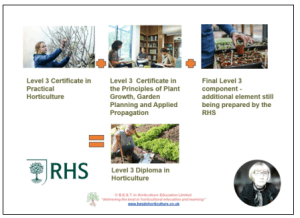
On successful completion of both unit examinations, you will be awarded an RHS Level 3 Certificate in the Principles of Plant Growth, Garden Planning and Applied Propagation at either Pass, Merit or Distinction.
Venue will be the Ryton centre.
Tuition fees £920, RHS fees £230, total fees £1150.
The RHS have made a decision that a Centre can only accept you on an RHS course if you commit to the complete assessment process when you start. So you have to pay the fees for registration and two examinations (£230) at the start of your course, because the RHS will invoice us for these fees as soon as we register you in the first week of the course.
You will be able to prepay £1150 for your complete course; or you will be able to secure your place on the course with a non-refundable booking fee, payable on enrolment, of 25% of the full cost of the course plus an administration fee (£292.50) towards initial RHS registration costs. Please note: In the event of a place not being available or if the course does not run, the booking fee will be returned to you.
The remainder of the course fees can be paid in three equal instalments of £292.50 on or around weeks 8, 16 and 24 of the course.
You will receive statements of account during your course but we do not sent out specific reminders for staged payments.
Payment methods:
Click on the 'enrol now' button below and complete an enrolment form.
It is recommended that learners will have successfully completed a level 2 course such as The RHS Level 2 Certificate in Horticulture or a suitable alternative.
You can go on to study The RHS Level 3 Practical Certificate, and you can progress to the RHS Level 3 Award in Horticultural Investigation and further develop your horticultural knowledge and skills to achieve an RHS Level 3 Diploma.
17th September 2025
09.30 am
£1120.00
Sorry, there is currently no availability for this course, for further information on when there will be availability for this course, please feel free to contact us.
£1,120.00
No seats available
This is the online classroom supporting students for the new Level 3 theory Certificate which is being taught at Ryton on Fridays in 2024-25.


We have collected together some quick links to useful pages that you should find helpful.
B.E.S.T in Horticulture Education Limited, Registered in England No 14088275. (A not for profit organisation)
B.E.S.T. in Horticulture Ltd. Registered in England № 7739766.